
 Growing Jobs
Fewer quality jobs push young Koreans to take whatever work they can get

(Getty Images)
Park, 27, a university graduate who majored in computer science, is on a six-month contract at a subsidiary of a public enterprise after previously working on a one-year deal at an IT company in finance.
Though hoping his major would help him secure a job at a leading IT company, he is now looking at other opportunities like jobs in the government sector.
“I chose a contract position with the mindset that it’s better to get paid and gain a bit of experience rather than not working while job hunting,” Park said. “I can really feel how hiring has decreased due to the rise of artificial intelligence.”
On what he wants most from the recruitment process, his immediate reply was “A decent job.”
Lee, 29, who is on the hunt for a job, stopped working part-time gigs after graduating from university in 2024 to focus on finding a job, but has not yet found a suitable position. Given the mounting financial burden from living expenses and testing fees because of the prolonged job search, Lee returned to work as a contract employee at a coffee chain.
“I plan to work part-time only until I land a permanent job,” Lee said. “Even at non-conglomerate companies, the competency assessment phase has grown longer and poses questions about the use of AI. It feels like the hiring process is getting increasingly rigorous.”
A growing number of young people like Park and Lee are lowering their expectations and choosing to work while knocking on the doors of an increasingly restricted job market. The youth employment quality index of the Bank of Korea (BOK) has deteriorated relative to pre-COVID-19 levels, even as quantitative job indicators like unemployment and hiring rates have improved, in a sign of the worsening job market for the younger generation.
The prime reason for the decline in job quality for young people is the restructuring of the domestic industrial landscape toward IT. Led by semiconductors, IT boasts high productivity but low job generation.
“In IT manufacturing, the hiring of regular staff has barely seen growth despite the major jump in production,” said Chung Sung-yup, the head of the BOK’s labor market forecasting and analysis team. “In non-IT manufacturing, the hiring of permanent employees has plunged due to sluggish production, and the service sector has also cut such hires as a result of weak output.”
Moreover, the effects of this stagnant labor demand did not appear spread across age groups but rather concentrated among young people just entering the labor market. This is a primary factor for the deterioration in job quality for younger Koreans.
A BOK analysis based on data on the economically active population found that in the first half of this year, the number of newly hired permanent employees aged 15-29 who had worked 0-11 months at their jobs per 100 people fell by 1.8 compared to 2023.
Over the same period, the corresponding figure for the core working-age group aged 30-59 declined by only 0.8. This trend contrasts with 2019, the year before the pandemic broke out, when the number of new permanent staff rose by 1.1 among young adults and 1 for the core working-age group, from 2014.
The rapid proliferation of AI is another factor keeping young people out of the high-quality job market.
“Given rising preference for experienced workers, especially in roles and industries with high exposure to AI, demand for entry-level and basic tasks typically done by young workers is plunging,” Chung said. “This shift in the hiring landscape serves as a structural barrier limiting the entry of young people into the labor market for advanced industries with high exposure to AI.”
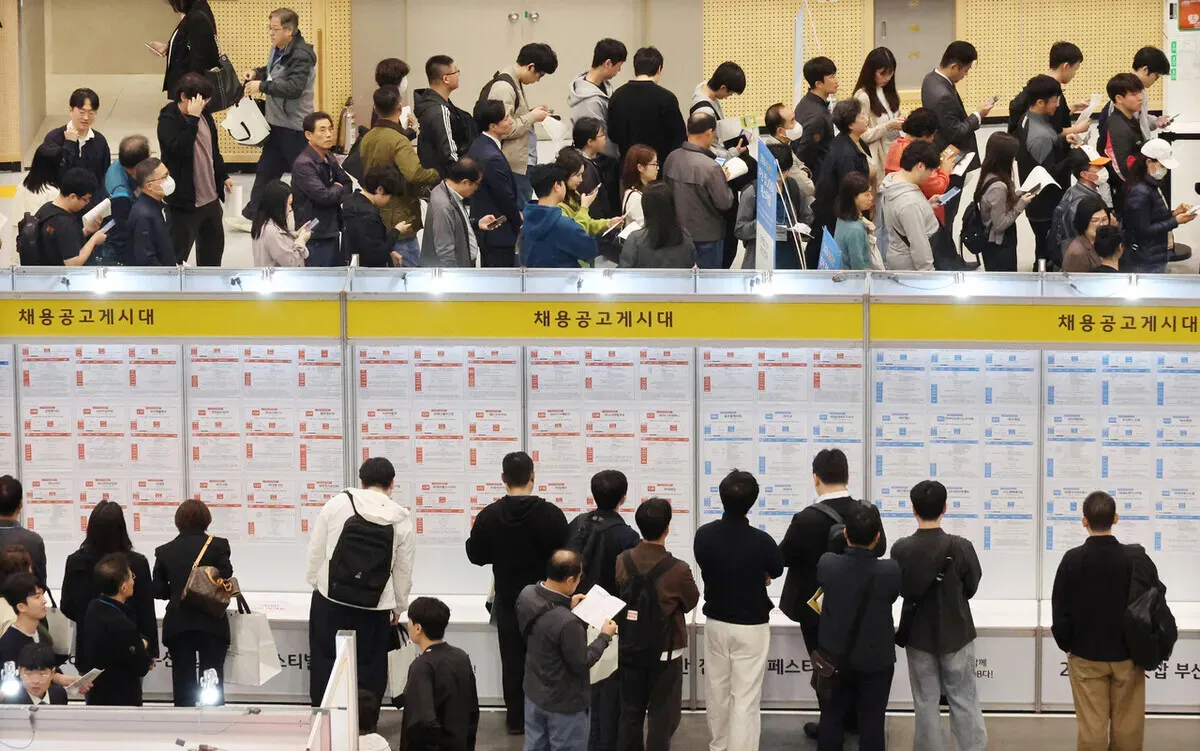
Jobseekers peruse wanted ads at a job fair at Busan’s BEXCO on Oct. 26, 2026. (Yonhap)
The rigid labor market has also gradually narrowed the path for workers to go from irregular to permanent staff.
BOK estimates, using data from the Korea Employment Information Service’s Youth Panel, a survey of the school-to-work transition, career trajectories and economic activities of young people, found that the probability of a worker in the “primary” labor market staying in the same job rose from 81.8% in 2014-2019 to 86.9% in 2023-2024.
Conversely, the probability of one in the “secondary” labor market comprising irregular staff and others moving into the primary market fell from 3.5% to 1.6% over the same period.
“Weak youth employment reflects the combined effects of industrial restructuring, advances in AI, and declining labor market mobility,” the BOK said. “A comprehensive approach is needed to create conditions for the robust growth seen in IT manufacturing to spill over into related sectors and the domestic market, while also organically linking education and industry.”
“The most important thing is to ensure that small and medium enterprises (SMEs) can offer higher quality jobs,” said Kim Yoo-bin, senior research fellow and director-general of the Employment Policy Research Division at the Korea Labor Institute.
“We need to consider measures like having large corporations who are prime contractors share the costs incurred to SMEs, subcontractors and similar companies to raise hiring of young people and improve wages and working conditions, as well as use surplus tax revenue and other resources to support such efforts,” he added.
By Kim Young-bae, senior staff writer; Kim Yoon-ju, staff reporter
Please direct questions or comments to [english@hani.co.kr]